Introduction
Cloud infrastructure decisions that once looked straightforward have become politically and strategically complex. Organizations that spent the last decade chasing scalability and cloud convenience are now grappling with the consequences: tighter privacy regulations, unpredictable trade dynamics, and growing pressure to demonstrate control over the data they hold. Digital sovereignty sits at the center of it all.
For most organizations, digital sovereignty means the practical ability to maintain authority over their infrastructure, data, and the software stack that processes it, without depending on vendors or jurisdictions that may not share their interests. That is a broader definition than data residency, and a more demanding one.
Digital sovereignty is not achieved by eliminating dependencies. It is achieved by ensuring that no single dependency can prevent the continued operation, maintenance, or evolution of critical infrastructure. The goal is managed interdependence: building on open standards, transparent governance, and a diverse ecosystem of trusted partners so organizations retain flexibility as technology, business requirements, and geopolitical conditions evolve.
Achieving that requires an open foundation. Proprietary software creates structural dependencies that can be difficult to inspect, replace, or sustain over the long term. Open source, by contrast, provides transparency, interoperability, and continuity. Open governance and community-driven development protect organizations from software "kill switches," abrupt licensing changes, and the loss of access that can occur when critical technology remains under the exclusive control of a single vendor.
This white paper examines how open infrastructure, built on the Four Opens (open source, open design, open development, and open community), provides the architectural principles and operational practices needed to build resilient, sovereign infrastructure.
Background and Context
Digital sovereignty has evolved from a niche regulatory concern into a critical strategic priority for nations and regulated industries worldwide. Digital sovereignty is an organization’s ability to exercise meaningful authority and independent control over its digital infrastructure, technologies, and data, aligned with its own policies and strategic objectives rather than those of an external vendor or foreign jurisdiction.
Implementing digital sovereignty is a collaborative pursuit, involving diverse organizational stakeholders who each safeguard distinct dimensions of technological independence and data control. The following roles are essential to an organization’s digital sovereignty strategy, driving the technological and governance controls necessary to maintain operational autonomy.
- Enterprise Architects: Responsible for designing modern, sovereign-capable platforms that balance innovation with long-term technological independence. They ensure infrastructure remains adaptable, interoperable, and free from vendor lock-in by prioritizing open standards.
- Primary Sovereignty Driver: Technological independence and reversibility.
- Key Responsibility: Architecting hybrid and multi-cloud strategies that prevent infrastructure dependencies and ensure workload portability.
- IT Security Practitioners: Focused on implementing architectural controls to satisfy stringent regulatory requirements while actively mitigating supply chain risks. They protect sensitive data from unauthorized access and extraterritorial interference.
- Primary Sovereignty Driver: Risk mitigation and data protection.
- Key Responsibility: Implementing technical safeguards like encryption (e.g., Bring Your Own Key or BYOK), confidential computing, and automated policy-as-code compliance.
- IT Operations, SREs, and System Administrators: Tasked with maintaining resilient, cloud-native infrastructure that ensures operational autonomy. They manage environments, often in disconnected or air-gapped setups, to maintain service continuity independent of external provider stability.
- Primary Sovereignty Driver: Operational autonomy and resilience.
- Key Responsibility: Owning the full operational lifecycle, including the upgrade path and security response, without reliance on foreign-domiciled support.
- Executive Leadership (CIO/CTO/CISO): Drive the strategic vision for digital sovereignty, balancing rapid transformation with long-term business resilience. They focus on reducing dependency on foreign technology providers to protect the organization's strategic interests.
- Primary Sovereignty Driver: Economic competitiveness and geopolitical risk management.
- Key Responsibility: Aligning technology investments with jurisdictional mandates and ensuring the organization's "digital destiny" remains under internal authority.
- Legal and Compliance Officers: Bridge the gap between regulation and operations by interpreting cross-border data transfer laws. They ensure that sovereign data protection standards are translated into actionable and enforceable internal policies.
- Primary Sovereignty Driver: Regulatory alignment and jurisdictional control.
- Key Responsibility: Assessing vendor domiciles and legal frameworks to insulate sensitive data from extra-territorial laws like the U.S. Clarifying Lawful Overseas Use of Data (CLOUD) Act.
- Data Privacy Officers (DPOs): Act as guardians of individual data rights, ensuring sovereignty strategies are built upon privacy-by-design principles. They mandate strict adherence to global data-handling requirements, such as the European Union’s General Data Protection Regulation (GDPR) and Digital Operational Resilience Act (DORA).
- Primary Sovereignty Driver: Trust, transparency, and data residency.
- Key Responsibility: Verifying that data residency claims are backed by technical audits rather than just contractual assertions.
Why Digital Sovereignty? Key Scenarios
Several distinct pressures push organizations toward sovereignty. The scenarios below represent the most common starting points:
- Scenario 1: Discovery-Driven Audit and Assurance Sovereignty
Organizations often begin their sovereignty journey by conducting deep discovery and audits of their digital footprint. This process involves mapping complex data flows and infrastructure dependencies to identify vulnerabilities. This audit is the foundation for aligning with frameworks such as DORA, the Cooperative Association for Internet Data Analysis (CAIDA), and the European Union Cyber Resilience Act (CRA), and for establishing jurisdictional control from the ground up rather than retrofitting it later. - Scenario 2: Regulatory Evolution and Strategic Independence
The landscape of data privacy is becoming increasingly fragmented and strict. From the EU’s GDPR to evolving global mandates — such as India's Digital Personal Data Protection (DPDP) Act or China’s Personal Information Protection Law (PIPL) — organizations face the challenge of managing "where" and "how" data is processed. - Scenario 3: Economic Resilience and Technical Sovereignty
Proprietary hyperscale cloud environments often introduce "hidden" costs, such as unpredictable egress fees and opaque pricing models, which threaten long-term fiscal viability. Organizations are shifting toward "Technical Sovereignty" by adopting open source standards and hybrid infrastructure models. This approach prevents vendor lock-in, enables workload portability, and ensures that the technology stack remains adaptable, interoperable, and cost-efficient. - Scenario 4: Geopolitical Stability and Operational Resilience
In an era of international trade disputes and shifting geopolitical alliances, organizations must shield their operations from the impact of sudden service revocations or external dependencies. Achieving "Operational Resilience" requires shifting to a comprehensive autonomy model — one that utilizes local support, air-gapped environments, and independent technology stacks. This autonomy model ensures operational continuity, allowing critical services to persist independently of foreign-domiciled providers or international instability.
Aspects of Sovereignty
Strategic Independence
Strategic independence is the right and practical capacity of an organization, jurisdiction, or individual to control the collection, storage, processing, and transfer of their data in accordance with applicable laws, policies, and values. It is not merely a question of where data physically resides anymore, but of who exercises effective authority over that data — including authority over the legal framework that governs it, the encryption keys that protect it, and the operational processes that manage it. With Open Infrastructure projects, organizations can have that level of authority.
Strategic independence aims to address three key issues:
- Jurisdiction: Which legal framework governs the data, and which authorities can compel access to it?
- Control: Who holds the technical and operational means to access, modify, move, or delete the data?
- Protection: How is data secured against unauthorized access, disclosure, or loss, and who controls the means of that protection (e.g., encryption keys)?
Crown Jewels
Not all data carries the same sovereignty requirement. A foundational principle of practical data sovereignty is proportionality: the degree of control, localization, and protection applied to data should reflect its sensitivity and the consequences of its compromise or misuse.
Categories that typically warrant the strongest sovereignty controls include:
- Personal health records — subject to stringent requirements in virtually all jurisdictions [e.g., France's Health Data Hosting certification, the U.S.’s Health Insurance Portability and Accountability Act (HIPAA) in the US, and National Health Service (NHS) frameworks in the UK]
- Financial transaction data — increasingly regulated under frameworks such as the EU's DORA, the UK Prudential Regulation Authority's Supervisory Statement on Outsourcing and Third-Party Risk Management (PRA SS2/21), and the Monetary Authority of Singapore’s Technology Risk Management framework (MAS TRM).
- Critical national infrastructure data — operational data from energy, transport, water, and communications sectors
- Government and classified data — subject to sovereign requirements that may prohibit processing outside national boundaries entirely
- Personally identifiable information (PII) — regulated broadly under GDPR, Québec Law 25, India's DPDP Act, Brazil's Lei Geral de Proteção de Dados (LGPD), China's PIPL, and equivalent frameworks
- A note on logs as PII: Audit, access, and system logs frequently constitute personal data in their own right. Log entries that capture IP addresses, user identifiers, session tokens, or timestamps of individual activity are treated as PII under GDPR and equivalent frameworks. Organizations should not assume that logs are operationally neutral — they must be assessed for PII content at the point of log design and classified and controlled accordingly.
- Intellectual property and trade secrets — commercially sensitive data whose sovereignty requirements are contractual and strategic rather than regulatory
Extra-territorial reach of foreign law
Several national legal frameworks assert authority over data held by organizations incorporated in their jurisdiction, regardless of where the data physically resides. Organizations should assess the jurisdictional exposure created by their choice of cloud provider, software supplier, and hardware vendor — not only the location of their data centers. China's Data Security Law (DSL Article 36) and Personal Information Protection Law (PIPL Article 41) serve as direct counterparts to this risk: they prohibit organizations in China from providing data to foreign courts or regulators without Chinese government approval, creating a formal blocking mechanism against foreign extraterritorial compulsion.
Data residency vs. data sovereignty (strategic independence)
Data residency — the physical location of data — is a necessary but insufficient condition for strategic independence. Data held in a domestic data center but operated by a foreign-controlled entity, or encrypted with keys managed by a foreign supplier, may not constitute sovereign data in a meaningful sense. True sovereignty requires residency, domestic operational control, and domestic control of key management.
Regulatory fragmentation
Data sovereignty obligations vary significantly by jurisdiction and sector. There is no single global framework. Organizations operating across multiple jurisdictions must map their data flows against each applicable framework. Organizations should verify current requirements with legal counsel.
OpenInfra’s Role in Strategic Independence
Architecture Principles
Sovereignty requirements must drive infrastructure selection — not the reverse. Data classification (by sovereignty tier) should precede any infrastructure decision, as high-sensitivity workloads impose constraints that cannot be retrofitted after deployment.
Core Technology Stack
OpenStack serves as the foundation for sovereign private and hybrid clouds, offering full software auditability, no vendor lock-in, operator-controlled encryption, and scheduler-enforced data residency through availability zones and host aggregates. These properties are not achievable with closed-source hyperscaler platforms.
OpenStack Barbican provides the key management layer. Production sovereign deployments require a PKCS#11 or KMIP backend — industry-standard interfaces for cryptographic key management — connected to a hardware security module (HSM) physically located within the sovereign boundary. Per-tenant key isolation, rotation capability, and audit logging are non-negotiable requirements, and audit logs themselves must remain within the sovereign boundary.
StarlingXTM addresses edge and distributed sovereign deployments, enabling data to be processed at the jurisdictional boundary without routing through central infrastructure. Its distributed cloud model supports centralized management while keeping data processing local — critical for Container Network Interface (CNI) operators, government edge deployments, and air-gapped environments.
Kata ContainersTM provides VM-level isolation for multi-tenant environments, using lightweight virtual machines to prevent cross-tenant access to the underlying kernel. For high-sensitivity multi-tenant workloads, this should be treated as a baseline requirement rather than an optional enhancement.
Key Implementation Requirements
- Sovereignty controls must be enforced as code (IaC/policy-as-code), not dependent on human compliance
- Key rotation must be verified before production deployment and tested regularly
- Key management roles must be separated from compute and storage administration through role-based access controls (RBAC), enforced at the system level rather than by policy alone.
- Residency claims must be verified through a technical audit, not a contractual assertion alone
Organizational Responsibilities
Security teams must test sovereignty controls through regular exercises — including key revocation, sub-cloud isolation, and cross-tenant access attempts. Procurement and legal teams must assess vendor domicile, require audit rights and compulsion notification clauses, and mandate operator-controlled key management for sensitive data tiers. Provider-managed key management is not an equivalent substitute.
Operational Resilience
Operating an infrastructure platform in a reliable and sovereign manner presents significant and ongoing challenges, often greater than those encountered during initial deployment. Operators must maintain the skills necessary to run the platform reliably without relying on parties outside the established trust boundary and must provide customers with full transparency into how that operational capability is sustained.
The following areas are central to an organization’s operational resilience:
Support & Operations staff
Providers must maintain staffing that is sufficient in both capability and capacity to deliver quality customer support and manage day-to-day platform operations. Where external support is engaged, that dependency should be disclosed to customers.
Personnel providing support and operations functions will have some degree of exposure to customer data. Implementing measures to limit that exposure — such as encryption, confidential computing, and log cleaning/anonymization — strengthens the sovereignty posture, as does making those measures transparent to customers.
Support and operations personnel are subject to the rules and laws of their employer, their country of residence, and, potentially, their country of origin. Customers may require that such staff, including personnel from supporting partner organizations, meet specific residency or nationality criteria, particularly where foreign legal frameworks could conflict with customers’ regulatory or strategic requirements.
Logging & Monitoring
Maintaining control of an infrastructure platform requires continuous visibility into its operational state. A comprehensive observability stack is necessary to record capacity, load, performance, failures, and security events, feeding into tooling that triggers alerts at defined thresholds and supports active investigation. Because not all issues are detectable in real time, a tamper-evident event log trail is also required to enable post-incident reconstruction, including in the event of a security breach.
Transparency about the observability stack enables customers to understand the granularity at which platform health is monitored. Providers should consider sharing high-level status information or operational dashboards to provide customers with meaningful visibility into the platform's current state.
Some observability tools are proprietary or rely on third-party SaaS services. Providers should disclose which data and metadata are exposed through such tooling so that customers can assess alignment with their sovereignty requirements.
Lifecycle Management
An infrastructure platform consists of a large set of software components; all of these can have bug and security fixes as well as upgrades that provide additional value for customers. In some cases, upgrades may also result in visible changes that may not be improvements for all customers, such as breaking changes or performance regressions for specific use cases.
The software components need to be managed, and fixes, updates and upgrades need to be deployed from time to time. Providers can build trust by being transparent about the versions of software in use, documented through a Software Bill of Materials (SBOM), and by maintaining clear policies that are followed consistently, with defined validation processes and advance customer notification when platform changes are deployed.
Supply chain
No software is free of bugs. Maintaining secure and reliable infrastructure requires continuous identification, remediation, and deployment of bug fixes and security updates throughout the software lifecycle. With proprietary software, organizations typically depend on a single vendor to develop, prioritize, and distribute those updates, making the vendor's commercial priorities and long-term viability an important operational consideration. Transparency throughout the software supply chain is therefore essential for assessing both technical and strategic risk.
Open source software strengthens software supply chain resilience by distributing knowledge, development, and maintenance across a broad ecosystem of contributors rather than concentrating responsibility within a single supplier. Organizations are not limited to one path for obtaining security fixes, support, or ongoing innovation. This diversity helps protect against software discontinuation, licensing changes, commercial disruption, or geopolitical events that could otherwise interrupt access to critical technology.
While permissive open source licenses allow organizations to maintain private downstream modifications, doing so over extended periods increases maintenance costs and technical debt as upstream projects continue to evolve. Contributing improvements back to the upstream community reduces long-term maintenance burden while strengthening the software ecosystem for all participants.
Providers should be transparent not only about the open source software they use, but also about how they sustain it. Customers benefit from understanding who is responsible for maintaining critical components, how vulnerabilities are addressed, how fixes are contributed upstream, and how new capabilities are developed through collaboration between internal engineering teams, partners, and open source communities. This transparency demonstrates both the long-term sustainability of the platform and the organization's commitment to the health of the broader ecosystem.
Incident handling
Incidents are an expected aspect of operating complex infrastructure; they arise from technology failures, external factors such as power outages or cyberattacks, and human error. Customers reasonably expect providers to minimize their frequency and severity.
When incidents do occur, open and timely communication is essential. Acknowledging the problem and providing transparent updates on the resolution status enables customers to respond effectively and limit downstream impact.
Operators are expected to learn from incidents. Transparent handling of those incidents reflects the learning culture of the operating organization and contributes to rebuilding and sustaining customer trust over time.
Within a network of operators, cross-organizational learning — including from customers operating compatible private cloud platforms — creates mutual benefit and raises the collective operational standard.
Knowledge building and sharing
Operational transparency into the processes, tools, and challenges not only benefits customer trust. It also helps customers who want to run a private platform (built with similar technology) in a hybrid setting, as well as other providers that run compatible platforms. While many operators are understandably selective about what they share, there can be a huge benefit in a network of collaborating providers that together form a resilient system for their customers. This network enables customers to achieve a level of sovereignty that would otherwise be impossible: they have very little lock-in to a single provider in this setup.
In a network of many providers, knowledge sharing may appear to carry an additional cost; however, in practice, the value returned from contributions made by others substantially exceeds that investment, fostering a learning culture and enabling a level of operational excellence that would be difficult for any single organization to achieve independently.
Open Operations
The current pace of software advancement has been made possible by the permissionless innovation model of open source, enabling individuals to collaborate on software development across teams, organizations, and even continents. Over the past few decades, the IT industry has broadly adopted this collaborative approach.
Software development collaboration, however, is only half of the DevOps and DevSecOps picture. Open Operations extends that same collaborative model to the operational aspects of running IT infrastructure. A growing number of organizations have formalized this commitment through the Open Operations manifesto, pledging to share operational knowledge and enable broader learning across the community.
Open Operations provides customers with the transparency necessary to build trust and creates pathways for smaller organizations to operate infrastructure environments successfully. By lowering barriers to entry and expanding the provider ecosystem, it increases customer choice in a more competitive market, ultimately extending practical sovereignty to a broader range of organizations.
Software Transparency
Software transparency is the ability of an organization or jurisdiction to exercise real control over the software it depends on: understanding how it works, auditing it, modifying it, and replacing it without a vendor's permission. This control is vital for achieving genuine technological independence and robustly defending systems against extra-territorial laws or interference.
Software transparency enables a defined jurisdiction to design, develop, and govern key digital technologies, ensuring that essential infrastructure aligns with national strategic interests. A central benefit is mitigating risks associated with complex or potentially vulnerable foreign supply chains. Open source software is a critical enabler of this pillar: its transparent, auditable nature provides a degree of control, adaptability, and long-term viability that proprietary alternatives cannot match. Open source transparency gives you protection against software kill switches, and forkability that provides long-term access to the technology.
The key requirements for achieving both software transparency and sovereignty focus on ensuring trust and control throughout the software lifecycle. The following principles define what that looks like in practice:
Open source as the foundation for sovereignty: Open source software provides the foundation for organizations pursuing digital sovereignty by ensuring that critical technologies remain transparent, accessible, and sustainable over the long term. Organizations can inspect source code, verify security and compliance, understand system behavior, and make informed decisions about the software they depend on, capabilities that proprietary platforms inherently limit.
Open source also strengthens operational resilience. Because development occurs within open communities under transparent governance, organizations are not dependent on a single vendor for continued access to critical technology. The ability to maintain, support, and, when necessary, fork software protects against abrupt licensing changes, software "kill switches," vendor withdrawal, or geopolitical events that could otherwise disrupt essential services.
Rather than eliminating dependencies, open source enables organizations to build a diverse ecosystem of trusted technology partners. Open standards and interoperable interfaces allow infrastructure to evolve over time, integrating new technologies and providers without requiring wholesale replacement of existing investments. This flexibility supports hybrid and multi-cloud architectures while reducing long-term strategic dependency on any single vendor or jurisdiction.
- Verifiable Trust in the Software Supply Chain: Verifiable trust requires rigorous, continuous processes to ensure the integrity and authenticity of every software component across the full lifecycle, from initial source code development and secure build environments through deployment and ongoing operations. Digital signatures, automated integrity checks, and comprehensive auditing mechanisms are the primary technical means of establishing and maintaining that trust.
- Reproducible Builds and Digital Signing: Establishing a zero-trust approach requires the strict enforcement of reproducible builds, ensuring binary artifacts can be independently verified against their source code. This approach is coupled with cryptographic digital signing, often utilizing frameworks like Sigstore, to provide non-repudiable proof of integrity and origin, thereby safeguarding the software supply chain against tampering, hidden backdoors, and unauthorized modifications.
- Comprehensive SBOM Management: Maintaining an SBOM is crucial for establishing verifiable trust by providing a complete, machine-readable inventory of all open source and proprietary components, licenses, and dependencies. This transparency is essential for rapidly identifying and mitigating vulnerabilities and ensuring regulatory compliance throughout the entire software supply chain.
- Sovereign Operating System (OS): A sovereign OS is a foundational computing environment that serves as a fully trusted and verifiable basis for all higher-level software and applications. It emphasizes complete architectural control, typically leveraging open source components to enable exhaustive transparency and independent security audits. By prioritizing localized development, maintenance, and support, a sovereign OS guarantees strict compliance with national security standards and effectively mitigates external supply chain risks.
As the preceding sections establish, achieving digital sovereignty requires addressing three distinct but interconnected areas: strategic independence, operational resilience , and software transparency.
The three pillars are interdependent. Maintaining data within a specific jurisdiction requires a technology stack that can be independently audited (software transparency) and operated under the organization’s own governance (operational resilience), with appropriately vetted personnel. A sovereignty strategy that addresses only one or two of these dimensions will have gaps that cannot be compensated for elsewhere.
Reference Architecture
1. Architecture Framework
- The system architecture aligns with the National Institute of Standards and Technology (NIST) Cloud Computing Reference Architecture (SP 500-292).
- Core cloud characteristics are defined in accordance with the NIST Definition of Cloud Computing (SP 800-145).
- Cloud service evaluation follows NIST SP 800-145 and Special Publication 500-322.
- The physical layer is built on commodity x86 hardware and is compatible with the ARM architecture.
- The virtualization layer leverages Kernel-based Virtual Machine (KVM) on Linux, an open source technology with broad community support and proven deployments.
- The core management layer utilizes OpenStack, an open source platform for centralized orchestration of compute, network, and storage resources, supporting both horizontal and vertical scalability with high flexibility.
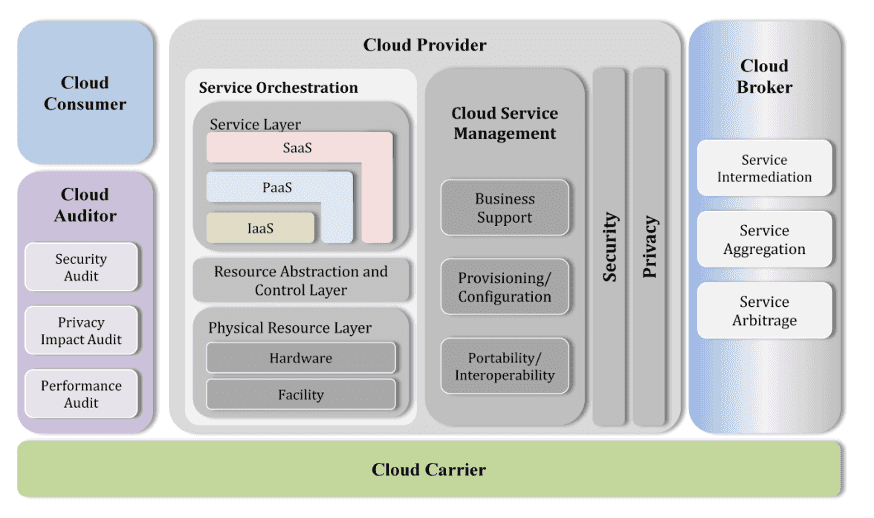
NIST Cloud Computing Reference Architecture 500-292
2. Design and Implementation Principles
To ensure high availability, fault tolerance, security, and data protection, the Cloud platform is designed and deployed based on the following principles:
- The system is built with no single point of failure, ensuring service continuity even when individual components fail.
- Recovery mechanisms are designed to be compatible across multi-vendor environments.
- Site-level redundancy is implemented at a minimum of 1+1 for critical components.
- Device-level redundancy is configured at least 1+1 in Active-Active or Active-Standby modes.
- Module and service redundancy (including management components) is implemented using Active-Active or Active-Standby configurations.
- System stability is ensured through adherence to standardized configuration best practices.
- Access control is enforced through access control lists (ACLs), security groups, and firewalls, with management and data traffic separated using VLAN and VXLAN segmentation technologies.
- Centralized control mechanisms are implemented for authentication, authorization, and auditing.
- Business Continuity Plans (BCP) are fully defined and regularly tested.
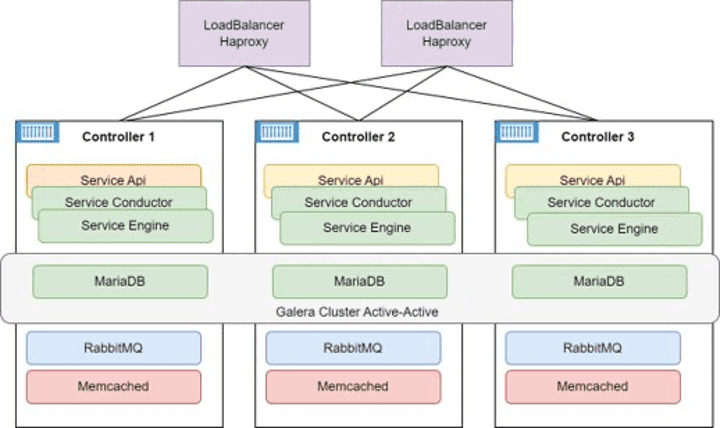
Platform Availability and Resilience Enhancements
-
Scalability and Load Handling:
The infrastructure is designed for high throughput and elastic scalability:- Core components such as databases, cache, and message queues operate in Active-Active mode.
- Cloud services are deployed in Active-Active or Active-Passive configurations.
- APIs follow a microservices architecture with load balancing for rapid scaling.
- The distributed virtual network architecture scales horizontally with compute expansion, eliminating bottlenecks.
-
Reliability:
The system is designed for rapid recovery and operational stability:- Rack-level redundancy: clusters are distributed across at least three racks, with control planes evenly distributed and sufficient standby resources.
- Hardware redundancy: network devices are deployed with at least N+1 redundancy per rack; servers use NIC bonding (aggregating multiple network interfaces for resilience) and RAID1 for storage.
-
Security:
Strong security controls and advanced protection mechanisms are implemented to safeguard customer data and prevent unauthorized access or attacks. -
Performance:
The infrastructure leverages modern technologies to optimize performance and maximize data throughput, ensuring it meets demanding workload requirements.
3. Overall Architecture
The system architecture is structured into five primary layers, comprising the following components:
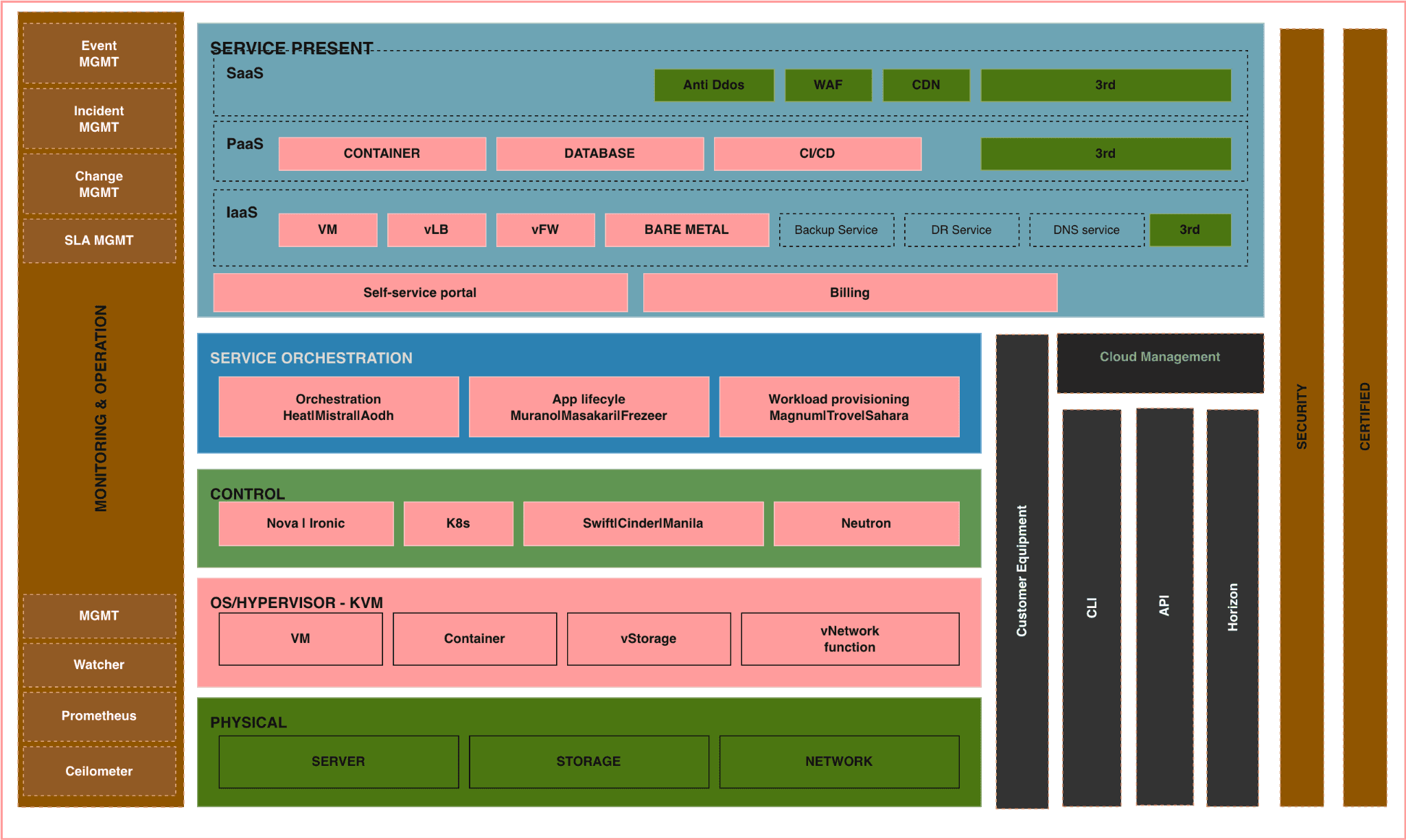
- Physical Layer:
Includes physical servers, SAN storage, software-defined storage systems, networking, and security devices. All components are based on commercial off-the-shelf (COTS) hardware, enabling multi-vendor integration and avoiding vendor lock-in. - OS/Hypervisor Layer:
The virtualization layer leverages open source technologies such as KVM, Open vSwitch, and software-defined storage. It provides hardware abstraction, resource pooling, and virtualization capabilities. - Control Layer:
Built on OpenStack, this layer orchestrates virtualization resources and manages interactions with the underlying hardware infrastructure. - Service Orchestration Layer:
Comprises open source projects and developed components to automate lifecycle management of services, including containers, databases, data analytics, and future service offerings. - Service Presentation Layer:
Provides cloud interfaces, including the Cloud Portal, CLI, and APIs, enabling users to interact with and manage cloud resources. - Monitoring and Operations System:
Ensures security and operational integrity through monitoring, event management, change management, and incident management processes aligned with ISO/IEC 27001, the international standard for information security management.